Medical information
About infectious disease treatment using our antibacterial drug
Policy for treatment of infectious diseases such as runny nose and otorrhea at our hospital
Resistant bacteria are widespread even in familiar community-acquired diseases such as HNK-TV and Asahi Shimbun reports.
In principle, we do not administer antibiotics based on the experience of most doctors in order to prevent the spread of resistant bacteria and the spread of treatment. For nasal discharge, otorrhea, etc., a Gram stain test is performed, and if white blood cells are eating bacteria poorly, it is judged to be the causative bacterium. We have them take the most effective antibacterial drug according to the type of causative bacteria in an effective amount and at effective intervals. Based on many years of research data. In Japan, the amount used is too small to emphasize safety, so even if it is effective at the beginning of the sale, it will become less effective over time.
The amount is adjusted according to the blood concentration and the transferability to the target tissue. Twice a day has no effect, and it may not be effective unless it is 3 times a day. As a result, I think that our hospital has a runny nose and treatment for otitis media is quick. Many patients who cannot be treated in pediatrics, otolaryngology, and internal medicine come to our hospital.
The director has been a top runner in ENT research and treatment for 45 years. The Gram stain test gives results in a short time. Although it is the basis of infectious disease treatment, there are very few places in Japan that perform such tests and select antibacterial drugs not only in otolaryngology but also in pediatrics and internal medicine.
In order to prevent the spread of resistant bacteria and worsening without improvement, all prescription drugs should be taken as prescribed. Please do not take it properly for your convenience, leave it and do not take it again at a later date. Different causative bacteria have different medicines.
This is an example I experienced just recently. I visited the hospital by looking at the internet because my otorrhea did not stop for about 2 weeks. There is a central eardrum perforation, and otorrhea (++) is observed. A large amount of purulent post-nasal drip is observed, causing coughing. There is purulent rheumatism and conjunctivitis is also complicated. It is a typical nasal sinusitis-conjunctivitis-otitis media syndrome. Gram stain of nasal discharge and otorrhea is Gram-negative small bacillus poor diet +. Therefore, the causative bacterium was presumed to be Haemophilus influenzae, and an appropriate antibacterial drug was prescribed, and otorrhea stopped 5 days later. The former doctor instructed to take CDTR-PI at 3 mg / kg twice a day. Although the absorbability is extremely poor, the prescription amount is as small as half, and it is necessary three times a day instead of twice a day (out of the common sense of pharmacodynamics).
About selection of antibiotics for infectious diseases in our hospital
When choosing antibiotics for infectious diseases such as otitis media and nasal sinusitis, most doctors choose antibiotics based on their experience (experience treatment). Then, only God knows whether the causative bacteria and antibiotics are properly matched.
At our hospital, we outsource the bacterial culture test and at the same time perform the Gram stain test in the clinic so that the patient can take the most accurate antibiotics from the first visit. As a result, we use different antibiotics.
In addition, the dosage and interval of oral administration are also used after knowing the pharmacokinetics of antibiotics.
Some doctors take the dose too low or need to take it 3 times a day twice, or vice versa, 3 times a day. This does not provide the power that antibiotics expect. It's not good to say that antibiotics are all right, and it's not good to take them properly.
There was a child patient who had a runny nose and coughing, and was prescribed by replacing various antibiotics at other otolaryngology hospitals. (Experiential treatment) However, since there was no improvement in the symptoms, I came to our clinic with the introduction of an acquaintance. I was diagnosed with sinusitis and a runny nose flowing into the trachea as the cause of my cough. Runny nose,
At the same time as requesting a bacterial culture test (4-5 days required for results to be obtained), at our hospital
A Gram stain test (rapid diagnostic method, found in about 30 minutes) was performed and the causative bacteria could be estimated, so an appropriate antibiotic was prescribed based on the test. Seven days later, when I visited the clinic, my runny nose and cough disappeared, and my mother was pleased and muttered what it was like for the past two months. When the antibacterial drug and the bacteria that cause the infectious disease are combined in this way, the symptoms improve in a short time.
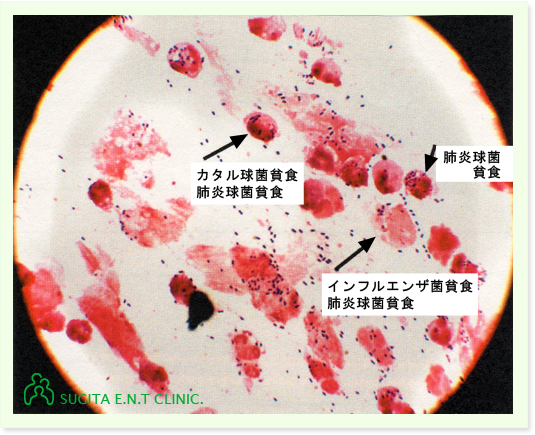
Gram stain test
Image of neutrophils phagocytosing catarrhal cocci, pneumococcus, and Haemophilus influenzae
(The bacteria that are being phagocytosed are presumed to be the causative bacteria)
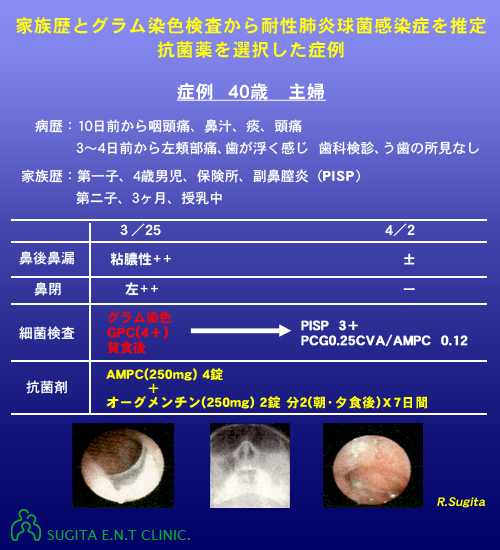
Actual case
Cases in which resistant pneumococcal infection was presumed from family history and Gram stain test, and antibacterial drug was selected